home overview research resources outreach & training outreach & training visitors center visitors center search search
Design Element

RBVI Workshops and Training
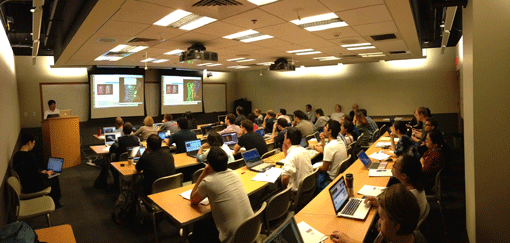
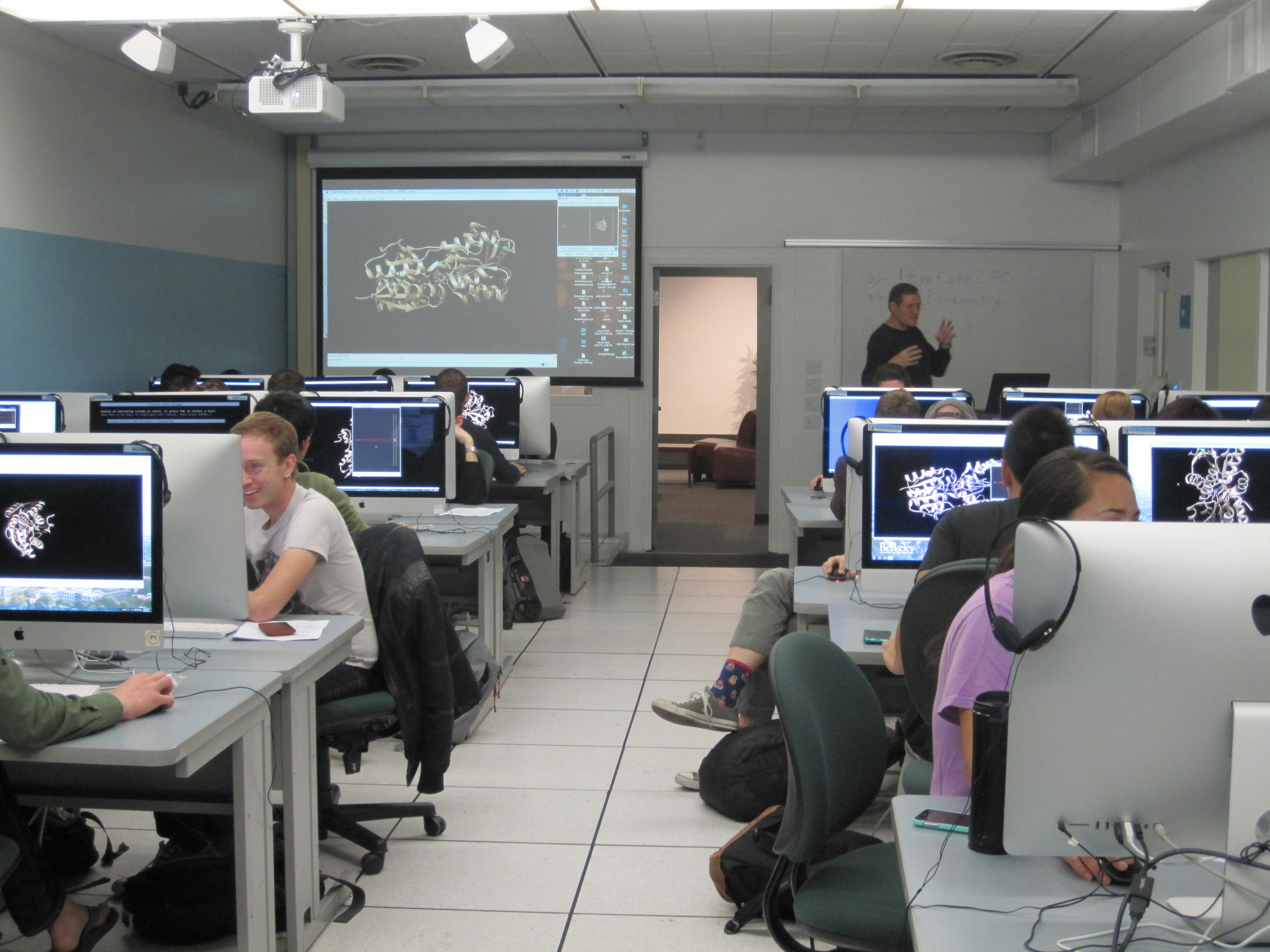
The RBVI provides several types of training on the tools we develop, from presentations at conferences to intensive workshops at UCSF or other sites. In addition, there are many online Chimera tutorials and Cytoscape tutorials, some developed for specific workshops, others as standalone materials.

Selected training events are listed below, with links to associated materials where available. See also Upcoming Workshops (below) and Selected Presentations.

Event Date Topics
Northern California Society for Microscopy meeting, UCSF Nov 15 2012 Viewing and analyzing microscopy data with Chimera; map segmentation [HTML]
Macromolecular Interactions course, UCSF BP204 Oct 17 2012 Chimera structural analysis and comparison; contacts and H-bonds, superposition, morphing, building multimers, working with sequences
Cytoscape workshop at NIH, Bethesda, MD Oct 4 2012 Network visualization and analysis with Cytoscape [workshop materials]
Chimera workshop at NIH, Bethesda, MD Oct 2-3 2012 Introduction to Chimera, structure analysis, sequence-structure tools, EM density analysis, publication images and movies [workshop materials]
Bay Area cryo-EM meeting, Santa Cruz Aug 27 2012 Making movies in Chimera, morphing EM maps and molecular structures of ParM [HTML]
Chimera training via WebEx for graduate students in structural and computational biology, Baylor College of Medicine Aug 14 2012 Chimera visualization of protein structures and sequences (dipeptide epimerase) and covering multiple length scales, from atoms to cells (T-cell tomography and termite gut EM)
Chimera hands-on training by teleconference, cryoEM workshop at the National University of Singapore Jul 12 2012 Electron tomography segmentation, molecule display, fitting; Q & A [HTML]
Chimera training for the DeGrado group at UCSF Jul 3 2012 Chimera structural analysis and comparison; H-bonds, superposition, morphing, attributes, working with sequences, density display, making movies; Q & A
Chimera workshop at the University of Missouri Apr 28 2012 Molecular visualization and analysis
Cytoscape workshop at the University of Missouri Apr 27 2012 Network visualization and analysis
Cytoscape tutorial at the Swiss Institute of Bioinformatics, Lausanne Mar 12-13 2012 Network visualization and analysis
Chimera tutorial at VIZBI 2012 (EMBO Visualizing Biological Data conference), Heidelberg, Germany Mar 5 2012 Basics of molecular visualization and animation
Cytoscape developer tutorial at VIZBI 2012, Heidelberg, Germany Mar 5 2012 Cytoscape plugin development
Chimera hands-on training at Indiana University Dec 1 2011 Building an α-crystallin model using EM and X-ray data; Chimera Q & A
Chimera hands-on tutorial at Purdue University Nov 30 2011 Building a ParM filament using an EM map and X-ray structure
Enzyme Function Initiative November-December meeting Nov 30 2011 New features in the Structure-Function Linkage Database
Macromolecular Interactions course, UCSF BP204 Sep 30 2011 Chimera structural analysis and comparison; contacts and H-bonds, superposition, morphing, building multimers, working with sequences
Introduction to Bioinformatics course, UCSF BMI206 Sep 23 2011 Enzyme annotation using protein similarity networks in Cytoscape
Introduction to Bioinformatics course, UCSF BMI206 Sep 21 2011 Introduction to the Structure-Function Linkage Database
19th Annual International Conference on Intelligent Systems for Molecular Biology (ISMB), Vienna, Austria Jul 16 2011 Analysis and visualization of biological networks with Cytoscape [PDF]
Seminar at the Swiss Institute of Bioinformatics, Lausanne, Switzerland Jul 11-12 2011 Analysis and visualization of biological networks with Cytoscape [PDF]
Gordon Conference on “Three Dimensional Electron Microscopy,” Colby-Sawyer College, NH Jun 26-Jul 1 2011 Global, sequential, and symmetric fitting of structures into EM density; Chimera Q & A
Cytoscape training, UCSF Jun 8 2011 Using Cytoscape with proteomics data
Enzyme Function Initiative May meeting May 24 2011 New features in the Structure-Function Linkage Database
Cytoscape Retreat, San Diego, CA May 19 2011 Using Cytoscape and selected plugins
Workshop on Visualizing Biological Data (VIZBI) 2011, Broad Institute, Cambridge, MA Mar 19 2011 Using Cytoscape and clusterMaker, structureViz, chemViz, and nodeCharts plugins
EMAN single particle reconstruction workshop, University of Houston, TX Mar 14-17 2011 Chimera EM tools including fitting, symmetry, presentation graphics [PDF] [data zip] [video]
Chimera training in protein engineering course, UC Berkeley, CA Oct 27 2010 Chimera structural analysis, morphing, trajectories, sequences, rotamers, building multimers, stereo
Chimera training for Department of Computational and Systems Biology, University of Pittsburgh, PA Sep 29 2010 Chimera demonstration and “Getting Started” tutorial
Macromolecular Interactions course, UCSF BP204 Sep 29 2010 Chimera structural analysis, working with sequences, morphing, attribute display, building multimers
Enzyme Function Initiative (EFI) meeting, UCSF Aug 16 2010 2-hour tutorial on using SFLD and working with networks in Cytoscape [PDF] (text-only)
Computational Systems Bioinformatics (CSB) conference, Stanford, CA Aug 16 2010 Analysis and visualization of biological networks with Cytoscape
Cytoscape Developer Retreat, Ann Arbor, MI Jul 18 2010 2-hour introductory user tutorial, demonstration of plugin CyCommandHandlers
Summer School 2010, Universitat Autonoma de Barcelona, Spain Jun 16-17 2010 Python programming and Chimera [PDF]
Cytoscape training for Burlingame group, UCSF Mar 17 2010 Network visualization and analysis with Cytoscape
Automated Molecular Imaging (AMI) forum, Scripps Research Institute, La Jolla, CA Feb 11 2010 Chimera segmentation and fitting capabilities
Cytoscape training for Cell Signaling Technologies, Salem, MA Feb 1 2010 Network visualization and analysis with Cytoscape
Introduction to Bioinformatics course, UCSF BMI206 Oct 23 2009 Cytoscape and the structureViz plugin
EMBO practical course, Grenoble, France Oct 20 2009 Combining EM and X-ray data for structure determination of large complexes [HTML] [PDF] [data zip]
Macromolecular Interactions course, UCSF BP204A Sep 30 2009 Chimera structural analysis, working with sequences, morphing, attribute display, building multimers
EMBO European School of Genetic Medicine course Sep 22 2009 Analysis of biological networks with Cytoscape
American Chemical Society National Meeting, COMP, Washington, DC Aug 19 2009 Chimera structural analysis, morphing, presentation graphics
UCSF Library Course Series: UCSF Chimera Mar-May 2009 Seven 2-hour sessions (details below)
Asia-Pacific Congress on Electron Tomography Feb 1 2009 Interactive visualization of spikes, pores, and cages with Chimera
Automated Molecular Imaging (AMI) forum, Scripps Research Institute, La Jolla, CA Jan 23 2009 Chimera tools for electron tomography

UCSF Library Chimera and Cytoscape Series

Molecular Visualization with UCSF Chimera: Getting Started

This session will go over the basics of molecular visualization and provide an introduction to how to use UCSF Chimera to load, visualize, and manipulate protein structures. Topics include: installing Chimera; Chimera menus and commands; fetching protein structures from ModBase and PDB; selections and actions; depictions; key tools: Side View, Model Panel, and the Selection Panel; and saving your work: sessions and images.

Participants should have a basic understanding of protein structure. All participants will receive a CD with UCSF Chimera installers for Mac, PC, and Linux as well as example files and additional exercises.

Scooter Morris & Conrad Huang Tuesday March 31, 2009 10am-12pm Mission Bay Community Center Library Analyzing and Comparing Structures with UCSF Chimera

This session will cover general structure visualization and analysis with Chimera. Topics include: identifying hydrogen bonds and contacts; measuring distances and angles, rotating bonds; viewing amino acid sidechain rotamers, "mutating" residues; displaying attributes such as B-factor and residue hydrophobicity; superimposing and comparing structures, morphing; viewing NMR ensembles and molecular dynamics trajectories.

Participants should have some knowledge of protein structure and molecular graphics, but expertise with Chimera is not required. Participants are encouraged to bring structures of interest (or note their Protein Data Bank IDs for retrieval in the lab) as "real-life" examples to supplement the provided exercises.

Elaine Meng & Scooter Morris Tuesday April 7, 2009 10am-12pm Mission Bay Community Center Library
Course materials Exploring Sequence-Structure Relationships with UCSF Chimera

This session will cover working with protein sequence alignments together with 3D structures. Topics include: customizing alignment appearance in Chimera; sequence-structure association and crosstalk; calculating sequence conservation and displaying it on structures; matching (superimposing) structures using an alignment; comparing structures of the same protein or different but related proteins; creating sequence alignments in Chimera; other sources of sequence alignments.

Participants should have some experience using Chimera and a basic understanding of protein structure and sequence alignments. Participants are encouraged to bring data on systems of interest (structure IDs, and if available, corresponding sequence alignments) as "real-life" examples to supplement the provided exercises.

Elaine Meng & Eric Pettersen Tuesday April 14, 2009 10am-12pm Mission Bay Community Center Library
Course materials Electron Microscope Tomography in UCSF Chimera

This course provides hands-on training exploring electron tomography maps. You'll learn to trace membranes, mask and extract structures, filter data, and fit models in cellular tomograms containing microtubules, nuclear pores, vesicles and assorted subcellular structures. Chimera map capabilities are also useful for single-particle EM reconstructions and x-ray crystallography maps and researchers studying those data types may benefit from this course.

Participants should have familiarity with Chimera.

Tom Goddard Tuesday April 21, 2009 10am-12pm Mission Bay Community Center Library
Course materials Publication-Quality Images with UCSF Chimera

This session provides hands-on training for creating images for journal articles and presentations. You will be introduced to the myriad of options to enhance your graphics: presets, depth cueing, transparency, silhouette edges, lighting, shininess, text labels, clipping and capping, color choices, raytracing, supersampling, subdivision quality, transparent backgrounds for image compositing, ribbon styles, stereo pairs, fish eye views, ambient occlusion, and lenticular images. Then you'll try some of these techniques on your own data (downloaded or brought on a flash drive or CD) or with example data we provide.

Participants should have familiarity with Chimera.

Greg Couch Tuesday April 28, 2009 10am-12pm Mission Bay Community Center Library
Course materials Movie Making with UCSF Chimera

This course provides hands-on training creating movies of molecular models for journal articles and presentations. You'll create an animation showing a ligand binding to a receptor with morphing between unbound and bound states. Titling, movie encoding, animation commands, and effects (edging highlighting, shininess, smoothing) will be covered.

Participants should have familiarity with Chimera.

Tom Goddard Tuesday May 5, 2009 10am-12pm Mission Bay Community Center Library
Course materials Customizing and Tailoring UCSF Chimera

This session will cover methods for customizing Chimera for specific tasks and projects, writing command scripts, and programming Chimera in Python. Other topics will be covered based on attendees interests. Please send mail to rbvi-workshopscgl.ucsf.edu if you would like to see a specific topic covered in depth. Possible topics include (but are not limited to): per-frame scripting of molecular dynamics trajectories; using the Demo Editor; adding user-defined headers to sequence alignments; writing Chimera extensions or commands.

Participants should have hands-on experience with Chimera.

Eric Pettersen & Conrad Huang Tuesday May 12, 2009 10am-12pm Mission Bay Community Center Library

Upcoming Workshops Offered by the RBVI

The RBVI offers workshops covering the use of the technology and tools we have developed as part of various research projects. Workshops are held at UCSF or at institutions with a significant enough user base to make it feasible for us to send a team to the users rather than bringing the users to UCSF.

We have no workshops scheduled at this time.

If you are interested in hosting a workshop at your institution, please contact us: rbvi-workshops@cgl.ucsf.edu.


Laboratory Overview | Research | Outreach & Training | Available Resources | Visitors Center | Search