RBVI Workshops and Training
|
The RBVI provides several types of training on the tools we develop, from presentations at conferences to intensive workshops at UCSF or other sites. In addition, many tutorials are available online: [Chimera] [ChimeraX] [Cytoscape] target="_blank">Cytoscape] We often hold workshops at other institutions that have a significant enough user base to make it feasible for us to send a team to the users rather than bringing the users to UCSF. If you are interested in hosting a workshop at your institution, please contact us: rbvi-workshops@cgl.ucsf.edu. |
Selected training events are listed below, with links to associated materials where available. See also Selected Presentations.
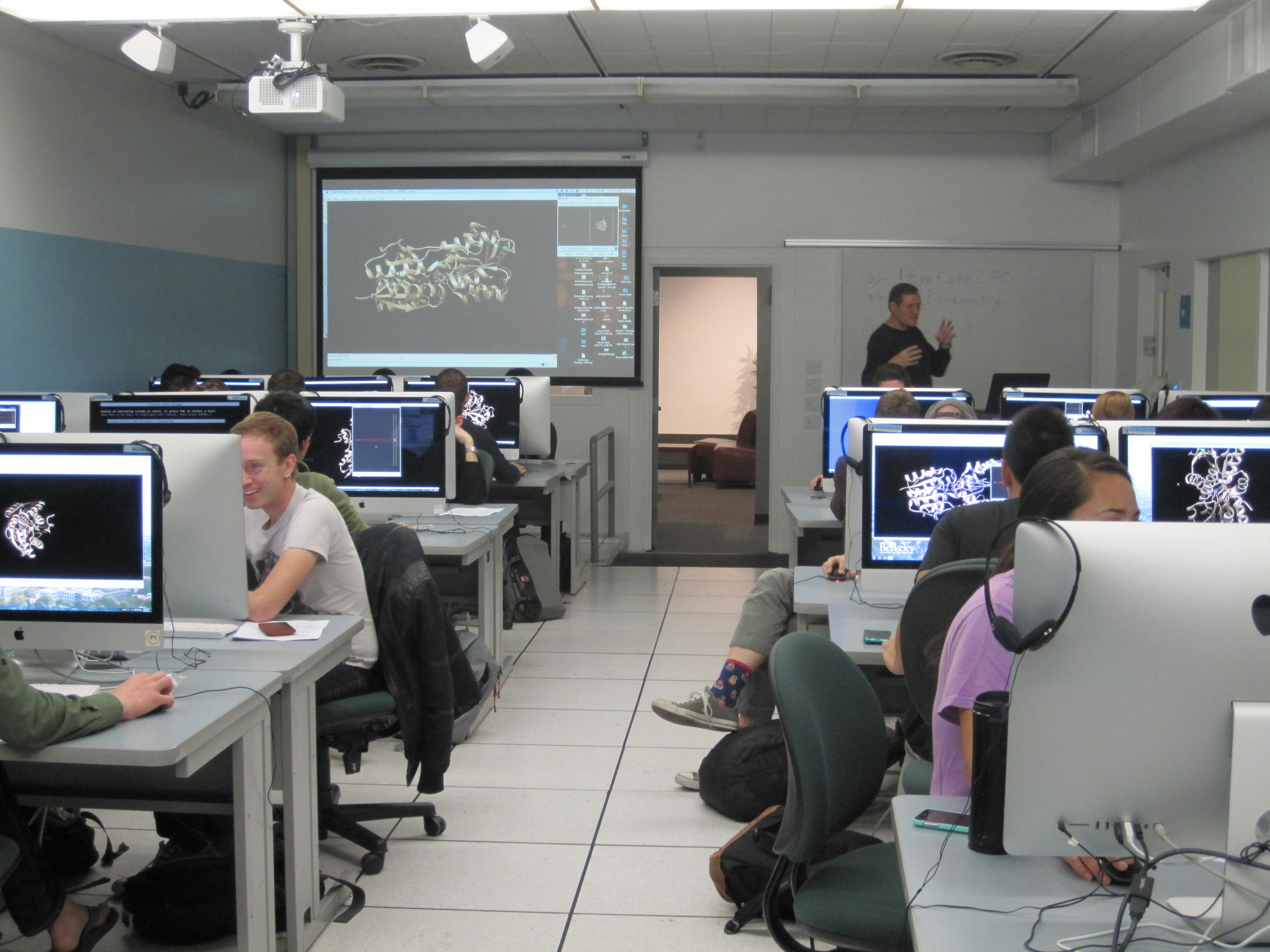
Event Date Topics NMR and EM experimental methods course, UCSF Biophysics 204A Dec 11 2017 Using Chimera to compare HSP90 ligands via superposition and hydrogen-bond display [HTML] and to fit HSP90 into a low-resolution map [HTML] NMR and EM experimental methods course, UCSF Biophysics 204A Nov 29 2017 Python scripting to create an attribute text file of chemical-shift perturbation values to read into Chimera, then using Chimera to color the HSP90 protein surface by the values [HTML]; ChimeraX virtual reality for ligand visualization Two-day protein-protein interactions workshop, Max Planck Institute for the Biology of Aging, Cologne, Germany Nov 27-28 2017 Cytoscape (day 1) and Chimera (day 2); combining network and structural analyses to investigate biological function ChimeraX demo for light microscopy researchers at UCSF Oct 5 2017 3D light microscopy data in ChimeraX, measuring distances in mitochondria, cell surface coloring from fluorescent marker, virtual reality ChimeraX webinar for SBGrid Consortium Apr 11 2017 Making movies of cryoEM data with UCSF ChimeraX [HTML] [YouTube] 2017 West Coast Protein Crystallography Workshop, Asilomar Mar 20 2017 Creating animations with UCSF ChimeraX: spin, morph, density fit, and virtual reality movies [HTML] Cytoscape workshop for the National Cancer Institute, Bethesda Sep 1-2 2016 Network visualization and analysis Chimera-Cytoscape workshop at the University of Colorado, Boulder Aug 15-16 2016 Two-day course covering structure analysis with Chimera and network analysis with Cytoscape Cytoscape workshop at the University of Southern Denmark, Odense Jul 29 2016 Introduction to network visualization and analysis PhD course on protein-protein interactions, Eötvös Loránd University in Budapest, Hungary Jun 6-7 2016 Two-day course covering both Cytoscape and Chimera; combining network and structural analyses to investigate biological function Penn State 2016 Bioinorganic Workshop Jun 5-8 2016 Two 4-hour hands-on workshops on using sequence similarity networks to aid in target selection, analyze metagenomics data, find linker sequences, and explore genomic context EMBO Practical Course: Computational analysis of protein-protein interactions: Sequences, networks and diseases, Budapest May 30-Jun 4 2016 Three-hour intro to Chimera, full-day tutorial on network biology and Cytoscape QCBNet workshop Visualizing & Modeling Cell Biology, Salt Lake City, UT May 2 2016 Hands-on Chimera tutorial on the visualization and analysis of 3D optical microscopy of crawling cells Biocuration 2016, Swiss Institute of Bioinformatics, Geneva Apr 14 2016 Defining functional boundaries within protein similarity networks Chimera training for UC Berkeley protein engineering course (ChmEng C270/BioE C219) Nov 20 2015 Intro to Chimera follow-along including basic manipulation, selection-action, H-bond identification, and morphing, then individually working through the structure analysis and comparison tutorial [photo, Tolman Hall computer lab] EMBO Practical Course: Computational analysis of protein-protein interactions: From sequences to networks, Norwich, UK Sep 28-Oct 3 2015 3-hour introduction to Chimera and a full-day tutorial on network biology and Cytoscape Videoconference presentation for graduate course in computational methods, Baylor College of Medicine Aug 4 2015 Discussion and demonstration of 3D image visualization Workshop at the University of Copenhagen Jul 20 2015 Use of Cytoscape, including interactions with UCSF Chimera 23rd Annual International Conference on Intelligent Systems for Molecular Biology (ISMB 2015), Dublin, Ireland Jul 11 2015 “Cytoscape 3 App Development: Variations on a theme – Hello World” all-day workshop during which students developed seven apps, each one building on the previous app and utilizing more of the Cytoscape API Chimera tutorial by Skype to Georgetown University structural biology course Apr 21 2015 Chimera BLAST searching, morphing, showing MD trajectories, virtual mutation, and rendering; customizing the Chimera interface UCSF Graduate Programs Minicourse Apr 21-May 7 2015 Protein function prediction from a big-data perspective using similarity networks Cytoscape course at UCSF Apr 7 2015 Introduction to Cytoscape VIZBI 2015 Visualizing Biological Data Conference at the Broad Institute of MIT and Harvard, Cambridge, MA Mar 24 2015 Introduction to Chimera tutorial, including visual effects, morphing, making movies, and MultiDomain Assembler